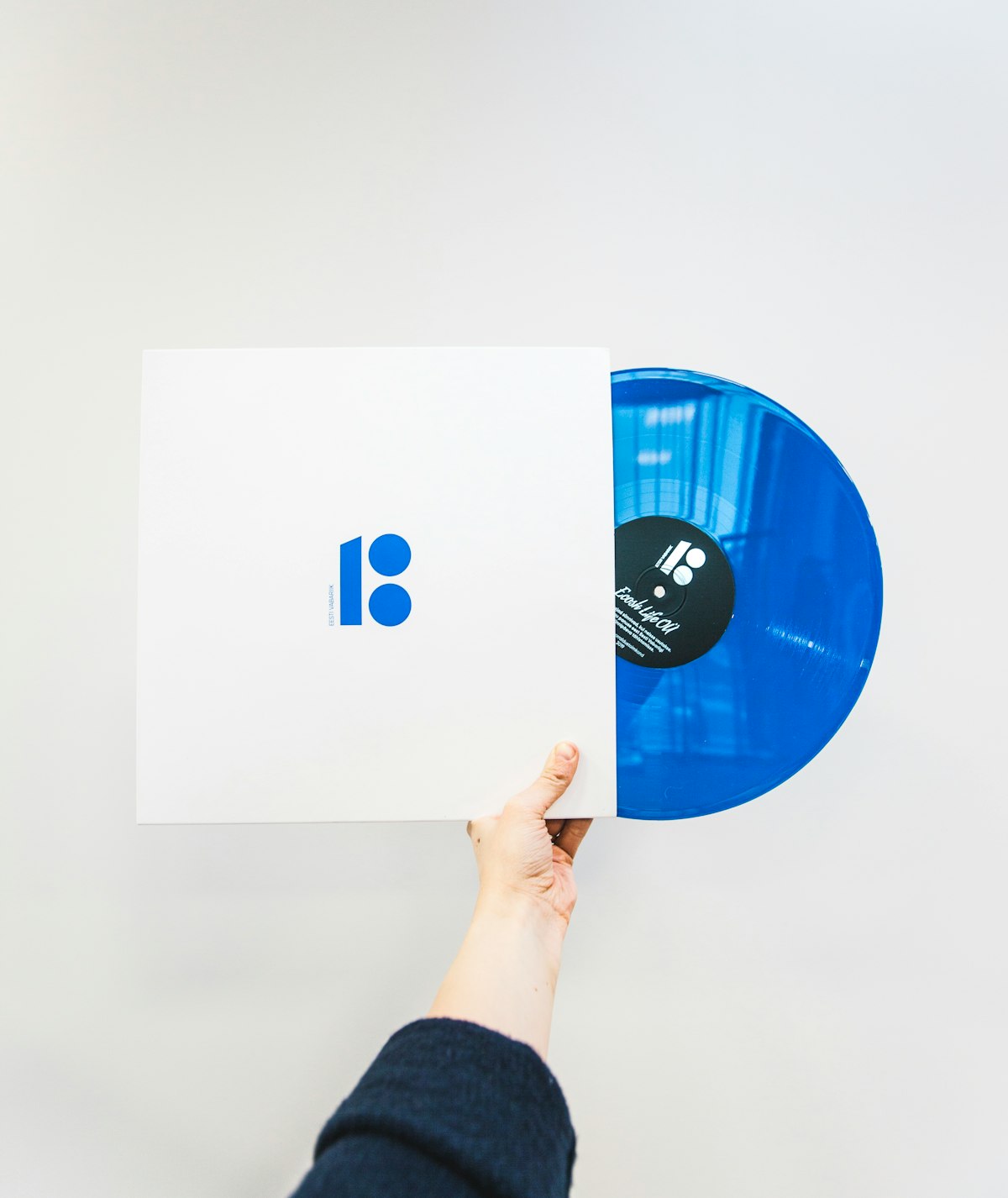
It's 2026's most reliably heated vinyl debate, right behind "is 180g actually worth it?" and just ahead of "does anyone really need a fourth copy of Rumours?" You've found the coloured pressing you want. It looks incredible. But somewhere in the back of your mind, a voice is telling you that coloured vinyl sounds worse than black. You probably read it on a Discogs forum thread at 1am. That the dyes ruin the sound. That you're buying a display piece, not a listening experience.
So. Does it?
The short answer: probably not in any way you'd notice. The longer answer involves a bit of chemistry, some manufacturing reality, and the uncomfortable truth that what sits between the grooves matters far less than what was done to the music before it got there.
(If you want the quick version alongside 180g, first pressings and the rest of the terminology, our pressing guide covers the basics. This piece goes deeper on the colour question specifically.)
What Actually Makes a Record Black
All vinyl records start life the same way — as pellets of PVC, which is naturally clear. To get that classic black, pressing plants add carbon black to the mix. Carbon black isn't just colouring. It's a functional additive that does three things: it strengthens the PVC, making the disc more rigid and resistant to deformation during pressing; it increases the material's electrical conductivity, which reduces static charge buildup (and therefore dust attraction); and it provides some UV resistance, which helps with long-term stability.
That conductivity point is the one that matters most for sound. Static electricity is vinyl's constant enemy: it pulls dust into the grooves, and dust in the grooves means noise on playback. Carbon black helps the charge dissipate rather than accumulate. It's the reason a black record fresh from the sleeve often sounds cleaner than a coloured one that's been sitting out, even if both are brand new.
Coloured vinyl replaces the carbon black with dyes or pigments. Different colours require different chemical compounds, each with their own melting points and flow characteristics. This is where the old reputation comes from. Decades ago, these dyes genuinely did produce less consistent results. The PVC behaved unpredictably under heat, the grooves formed with more variation, and the finished product often carried higher surface noise.
That was a real problem. In the 1980s and 1990s, coloured vinyl was widely regarded as a novelty. Something to look at, not to listen to critically. Forum posts from that era make for grim reading. The consensus was blunt: black sounds better, end of discussion.
What Changed (And Why the Old Advice Is Mostly Outdated)
Two things happened. PVC compounding got significantly better, and pressing plants invested in technology that handles coloured formulations with far more precision than was possible twenty years ago.
Modern pressing plants — places like Optimal Media in Germany, one of Europe's most respected facilities, or GZ Media in the Czech Republic, the world's largest vinyl manufacturer — use quality control processes and PVC formulations that have closed the gap almost entirely. The dyes used today are engineered specifically for vinyl production, with melting characteristics calibrated to the pressing process. They're not the same inconsistent pigments that gave coloured vinyl its bad name.
A well-pressed coloured record from a reputable plant is, for the vast majority of listeners, sonically indistinguishable from its black counterpart. Even most self-described audiophiles would struggle to identify the difference in a blind comparison on a decent system. A pressing plant engineer at dunk!pressing, a Belgian facility that specialises in coloured and effect vinyl for independent labels, put it plainly: modern manufacturing has virtually eliminated the quality gap.
The key phrase is "well-pressed from a reputable plant." The quality of the facility and the care taken during production matter enormously. A sloppy black pressing will sound worse than a careful coloured one every single time.
What Actually Determines How Your Record Sounds
If you're worried about audio quality, colour is genuinely one of the least important variables in play. Here's what makes the real difference.
The mastering. How the music was prepared for the vinyl format is the single biggest factor in how the finished record sounds. A great analogue master cut specifically for the format will sound superb on any colour of PVC. A lazy digital transfer with no adjustment for vinyl's physical limitations will sound flat and lifeless on black vinyl too. When a reissue is described as "mastered by Kevin Gray at Cohearent Audio", that's what you're paying for. Not the colour. Gray is the engineer behind definitive pressings of albums by Miles Davis, Bill Evans and hundreds of other artists for audiophile labels like Analogue Productions.
The stamper condition. Stampers are the metal moulds used to press records, and they wear down with each use. Early copies from a fresh stamper will have crisper, more precisely defined grooves than copies pressed near the end of the stamper's life. This affects high-frequency detail and overall clarity. Nothing to do with colour.
The PVC quality. Virgin PVC (made from new material with no recycled content) produces cleaner grooves with less background noise than formulations padded with recycled vinyl or cellulose fillers. Some budget labels cut costs here, and the result is audible regardless of what colour the record ends up being.
The pressing plant. Not all facilities are equal. A premium operation running rigorous quality control will produce a better record than a budget plant rushing through orders, whether they're pressing jet black or fluorescent pink.
The colour. Down here. Below all of those things.
The Colour Hierarchy: Some Are Trickier Than Others
That said, not all coloured vinyl is created equal. There's a loose hierarchy within the coloured world, and it's worth knowing about if you're choosing between variants.
Solid opaque colours, your reds, blues, greens, are essentially on par with standard black. Single-dye formulations behave predictably, and pressing plants have decades of experience with them. If you're buying a solid colour from a quality pressing, you can stop worrying.
Translucent colours, including clear blue, smoke grey, transparent red and amber, tend to perform well too. Some pressing engineers actually rate these highly because you can hold the record up to a light source and visually inspect the groove quality. It's a useful trick when you're buying used vinyl and want to check for damage that isn't obvious under normal light.
Splatter, marble and multi-colour pressings involve a more complex manufacturing process. Multiple dyes are combined, sometimes using manual techniques that introduce more variation between individual copies. The sonic impact is usually minimal on a well-made record, but the margin for inconsistency is wider than with a single colour. If you're buying splatter vinyl from a label that works with a reputable plant, you'll almost certainly be fine. If it's a small-run release from an unknown source, the gamble is slightly bigger.
White and pastel vinyl can be marginally more temperamental. Achieving those lighter shades often requires titanium dioxide and other additives that alter how the PVC flows during pressing. In practice, modern formulations handle this well — but if you're the kind of person who agonises over marginal differences, a solid darker colour or standard black is the statistically safer bet.
Glow-in-the-dark vinyl uses phosphorescent compounds mixed into the PVC. These are more novelty than audiophile choice, and the additives can affect groove precision slightly. They'll still sound perfectly listenable on most setups, but nobody's buying glow-in-the-dark vinyl for the sound. They're buying it because it glows in the dark, and that's a good enough reason.
Picture discs are the exception that proves the rule. A picture disc sandwiches a printed image between thin layers of clear vinyl, with the grooves pressed into the top surface. The manufacturing process is fundamentally different: the groove depth is shallower, the vinyl layers are thinner, and the image creates an uneven surface that the stylus has to navigate. The result is a record that looks fantastic and sounds noticeably worse: more surface noise, less dynamic range, faster wear. Picture discs are collector's items. Display pieces. Buy the standard pressing for listening.
How to Tell if a Specific Pressing Is Good
Instead of worrying about colour, spend two minutes checking the things that actually predict quality.
Check Discogs. The community there is obsessive about documenting pressing quality. Search for the specific release (not just the album, but the exact pressing, identifiable by catalogue number and barcode). If a coloured variant has problems, someone will have posted about it within days of release. Look for comments about surface noise, off-centre pressing, or mastering issues.
Check the pressing plant. Many labels now credit the pressing plant on the sleeve or in the liner notes. Optimal Media, GZ Media, Record Industry (Netherlands), Pallas (Germany) and The Vinyl Factory (UK) all have strong reputations. If the pressing plant isn't credited, the label's track record is your next best indicator.
Check the mastering credits. A named mastering engineer, particularly one who specialises in vinyl cutting, is a strong signal that care has been taken. Look for names like Kevin Gray, Bernie Grundman, Chris Bellman, or Miles Showell (who handles much of Abbey Road's half-speed mastering work).
Check the price. This isn't foolproof, but a £12 coloured pressing from an unknown label is more likely to cut corners than a £28 one from a label with a reputation to protect. The coloured vinyl market now accounts for roughly a third of all vinyl sold globally, and labels invest serious money in getting these right. Bad-sounding limited editions generate word-of-mouth that spreads fast in the collector community, and nobody wants that.
The Static Question
One legitimate difference between black and coloured vinyl is worth mentioning: static. Carbon black's conductive properties mean black vinyl does handle static charge slightly better out of the box. Coloured vinyl, lacking that conductive additive, can be marginally more prone to static buildup, which attracts dust.
This is a real difference, but it's easily managed. A carbon fibre brush before each play removes surface dust and discharges static on any record. Anti-static inner sleeves (MOFI or Spincare make good ones; see our storage guide) prevent charge buildup during storage. And an anti-static gun like the Milty Zerostat, while not cheap at around £60–70, eliminates the issue entirely for collectors who want to be thorough.
If you're already following basic record care practices — brushing before play, using decent inner sleeves, storing vertically — the static difference between black and coloured vinyl is negligible in real-world use.
So Should You Buy the Coloured Version?
If you like how it looks, yes. If the mastering is the same as the black pressing — which it almost always is, since both are cut from the same lacquer — you're getting the same music in a more visually interesting package.
If both versions are available at the same price, go with whichever appeals to you. If the coloured pressing is significantly more expensive purely because it's a limited run, that's a collecting decision rather than a sound quality one. That's a perfectly valid reason to buy it — coloured variants hold their value well and can appreciate significantly — but know what you're paying for.
The one scenario where black is the objectively safer choice is if you're buying a record specifically for critical listening on a high-end system and you want to eliminate every possible variable. In that case, black, 180g, from a premium plant with analogue mastering. But for the rest of us, which is nearly everyone, the colour of the PVC is the last thing worth worrying about.
A well-mastered, well-pressed record sounds brilliant in any colour. A poorly mastered one sounds flat in black. The plastic is just the container. What matters is what's in the grooves.